
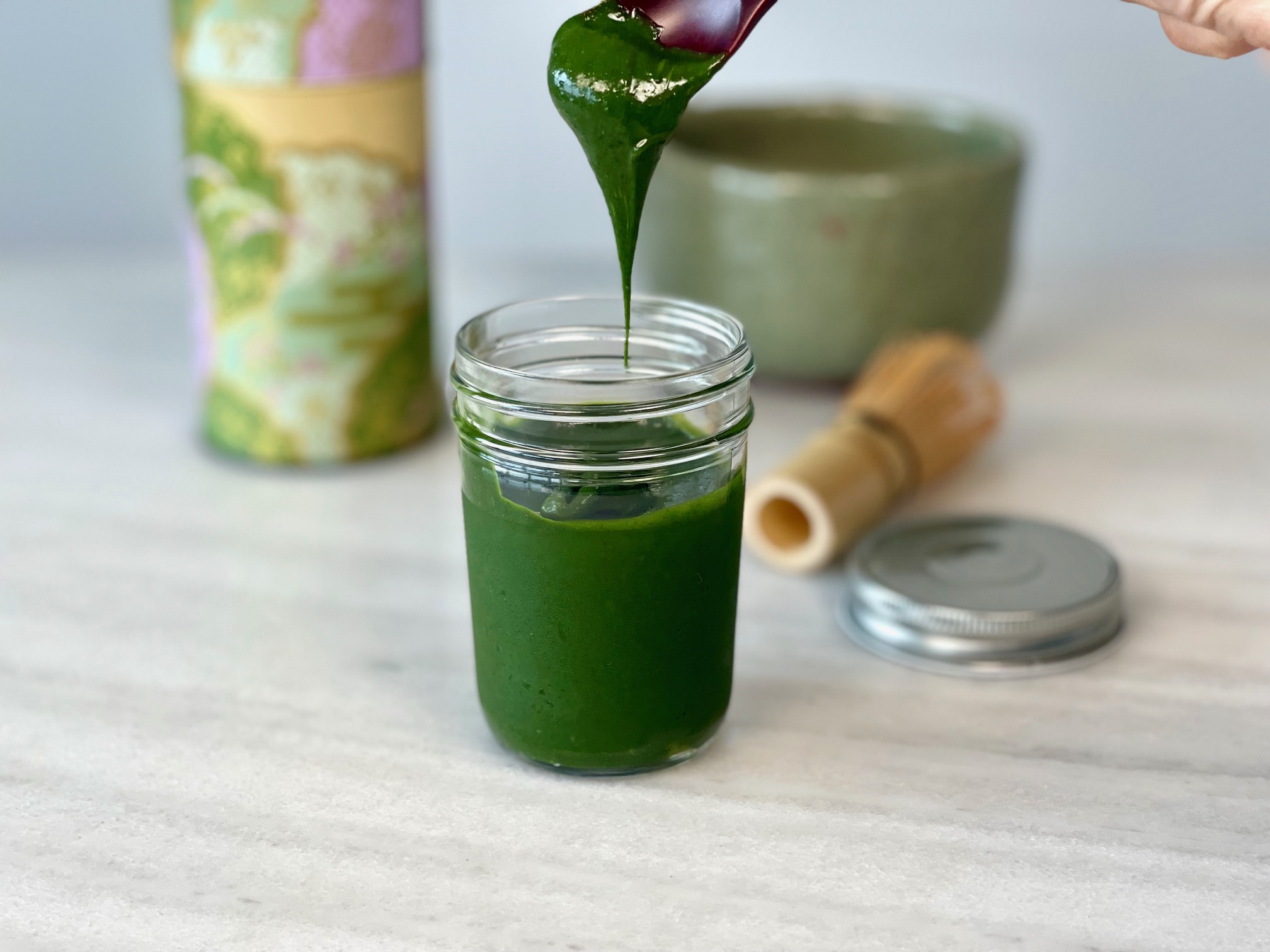
This matcha paste is a total game-changer. It’s my “secret weapon” for a perfectly smooth matcha latte in seconds, but it’s far more versatile than just a drink base. You can drizzle it over vanilla ice cream, spread it onto morning toast, or use it as a concentrated ingredient for matcha pudding, pastry cream, or even cheesecake.
The best part? You never have to deal with “matcha clump disasters” again. By making a batch when you have a free moment, you ensure your morning routine is faster, smoother, and much more elegant.
What Can I Make with Matcha Paste?
While it’s perfect for lattes, I use this paste as a building block for many of my favorite desserts. Check out how I use it here:

Matcha Fruit Toast : A vibrant, creamy breakfast.

Matcha Chocolate Dipped Ice Cream Bars : A vibrant, creamy breakfast.
The Science: Why Does Matcha Get Clumpy?


Unlike sugar or salt, matcha powder does not dissolve in liquid—it’s a suspension. Matcha is essentially a super-fine powder of ground tea leaves. When you mix it, you are suspending those particles in the liquid.
Clumps happen for several reasons:
- Skipping the sifting step.
- Using low-quality, non-stone-ground powder.
- Adding cold liquid too quickly.
- Insufficient whisking.
While you can whisk a perfect bowl of matcha every morning, it’s a lot of work. This paste does that labor once, so you don’t have to do it every day.
The Recipe: Professional Matcha Paste

Yields: Approx. 1/3 of a half-quart container (about 150ml). I recommend doubling this recipe for a full jar!
Ingredients

- Matcha Powder: 20g (approx. 3 tbsp) — High quality/Ceremonial grade preferred.
- Granulated Sugar: 80g (1/3 cup + 2 tablespoons)
- Heavy Cream: 100g (about 1/2 cup)
Step by Step

- Sift and Dry Mix: Sift the matcha powder through a very fine strainer into a medium bowl. Once sifted, add half of the sugar (40g) to the bowl and mix the dry ingredients together. This step is crucial; the sugar acts as a spacer, preventing the matcha from forming clumps once the liquid is added.

2. Heat the Liquid: Combine the heavy cream and the remaining half of the sugar (40g) in a small saucepan or a microwave-safe bowl. Heat until it reaches approximately 70°C (158°F)—the sugar should be fully dissolved. Do not let it boil.

3. Emulsify (The “Slow Pour”): Add the warm liquid to the matcha-sugar mixture one tablespoon at a time. Use a small whisk or spatula to mix thoroughly after each addition until a smooth, thick “slurry” forms. Repeat this 5 to 7 times. This gradual process is the key to a professional, silky texture.

4. Strain while Warm: While the paste is still warm, pass it through a fine-mesh sieve.
*Pro Tip: Straining while warm is much easier; once it cools, it becomes too thick to pass through easily.
5. Shock the Color: Immediately place the container in an ice bath. This rapid cooling “shocks” the matcha, locking in that brilliant, “electric” green color.
Storage: Protecting the Color & Flavor

Matcha is extremely sensitive to light, heat, and air. To keep your paste looking and tasting professional, follow these storage rules:
- Shelf Life: This paste is best used within one week. While it is safe to eat for longer, the vibrant green color will begin to oxidize and turn a duller olive-brown after 7 days.
- The “No-Clear” Rule: While my photos often show the paste in clear glass jars (because it looks so beautiful!), for actual storage, use an opaque or dark container. Light is the enemy of chlorophyll and will cause the color to fade rapidly.
- Minimize Air: Use the smallest container possible for your batch, or fill it as close to the top as you can. Less “headspace” in the jar means less oxygen touching your paste.
- Keep it Cold: Always store the paste in the back of the refrigerator where the temperature is most consistent.
Frequently Asked Questions about Matcha Paste
Can I make this without sugar?
Not recommended. Sugar is functional here; it acts as a preservative for shelf life and helps physically break down the matcha particles to prevent clumping. You can substitute agave or honey, but for the most vibrant green color, granulated sugar is best.
Can I use non-dairy cream?
Yes! You can use oat, soy, or coconut cream. The paste may be slightly looser in consistency than the heavy cream version, but it will still work perfectly for drinks and bakes.
Which Matcha should I use?
For the best balance of color and flavor, I recommend Ippodo Matcha. They offer a variety of stone-ground powders that are high quality yet affordable for home use.
Please also check this post “BEST 8 MATCHA FOR DRINKING AND BAKING.“

Matcha Paste
Ingredients
- 20 g Matcha Powder (High quality/Ceremonial grade preferred)
- 80 g Granulated Sugar (Divided into two 40g portions)
- 100 g Heavy Cream (Can substitute oat, soy, or coconut cream)
Instructions
- Sift and Dry Mix: Sift the matcha powder through a very fine strainer into a medium bowl. Add half of the sugar (40g) to the bowl and mix the dry ingredients together. This step is crucial; the sugar acts as a spacer, preventing the matcha from forming clumps.

- Heat the Liquid: Combine the heavy cream and the remaining half of the sugar (40g) in a small saucepan or a microwave-safe bowl. Heat until it reaches approximately 70°C (158°F) so the sugar is fully dissolved. Do not let it boil.

- Emulsify (The "Slow Pour"): Add the warm liquid to the matcha-sugar mixture one tablespoon at a time. Use a small whisk or spatula to mix thoroughly after each addition until a smooth, thick "slurry" forms. Repeat this 5 to 7 times to achieve a professional, silky texture.

- Strain While Warm: Pass the warm paste through a fine-mesh sieve. Straining while warm is essential; once it cools, it becomes too thick to pass through easily.

- Shock the Color: Immediately place the container in an ice bath. This rapid cooling "shocks" the matcha, locking in the brilliant, "electric" green color.
Notes
- Storage: Store in an opaque or dark container in the back of the refrigerator (light is the enemy of chlorophyll). Use the smallest container possible to minimize air exposure.
- Shelf Life: Best used within 7 days. It remains safe to eat after a week, but the vibrant green color will begin to oxidize and turn a duller olive-brown.
- Dairy-Free Substitutions: You can easily swap the heavy cream for oat, soy, or coconut cream. The resulting paste will have a slightly looser consistency but works perfectly for drinks and bakes.
- Sugar Substitutions: Granulated sugar is highly recommended as it preserves the vibrant green color and physically breaks down matcha particles. Agave or honey can be used, but the color will not be as electric.

13 comments
[…] Sauce or toppings – Tricolor Dango is delicious as is, but can also be topped with sweet soy glaze, sweet red bean paste (anko), sweetened sesame paste, or matcha paste. […]
[…] powder with a few drops of water in a cup or bowl to make a paste. 3. Once the milk is hot, add the matcha paste and whisk until frothy. 4. Add the sweetener, if using, and whisk to combine. 5. Pour into a cup […]
Hey! I just made the matcha paste yesterday. It was really delicious, and quite easy to make! I just want to ask, do you leave the paste in the fridge to preserve the flavour and freshness? And how long can you store the paste for, until it should be all used? Can we store it in a jar for a week? Thank you.
Thank you so much for trying it—I’m really happy you enjoyed it!
Yes, I recommend storing the matcha paste in an airtight container in the fridge to keep it fresh. Because matcha is quite delicate and can lose its flavor over time, I usually suggest using it within 3–4 days for the best taste and color.
You can keep it up to about a week in a jar, but the flavor and brightness may start to fade a bit. If possible, I recommend making smaller batches so you can enjoy it at its best 😊
I am excited to try this recipe. How long does the paste laste in the fridge?
Usually last two to three weeks depends on how to store it.
[…] you’ve created your matcha paste, it’s time to add the rest of the water around 2 to 3 ounces. The key here is the whisking […]
Thank you for adding this! Yes, after making the matcha paste, gradually adding about 2–3 oz of water while whisking is key to getting a smooth, well-balanced texture.
[…] you end up with bitter little pockets running through your batter. Always sift matcha first, then whisk it into a small amount of warm liquid or fat to make a smooth paste before combining with the […]
gziycnGlNSjAuXIPjpvuN
kxeIWWOUHLfJraQjCOl
Simple and easy to understand. Looks very yummy.
Wow!!looks amazing and easy to make! Thank you for the recipe!