
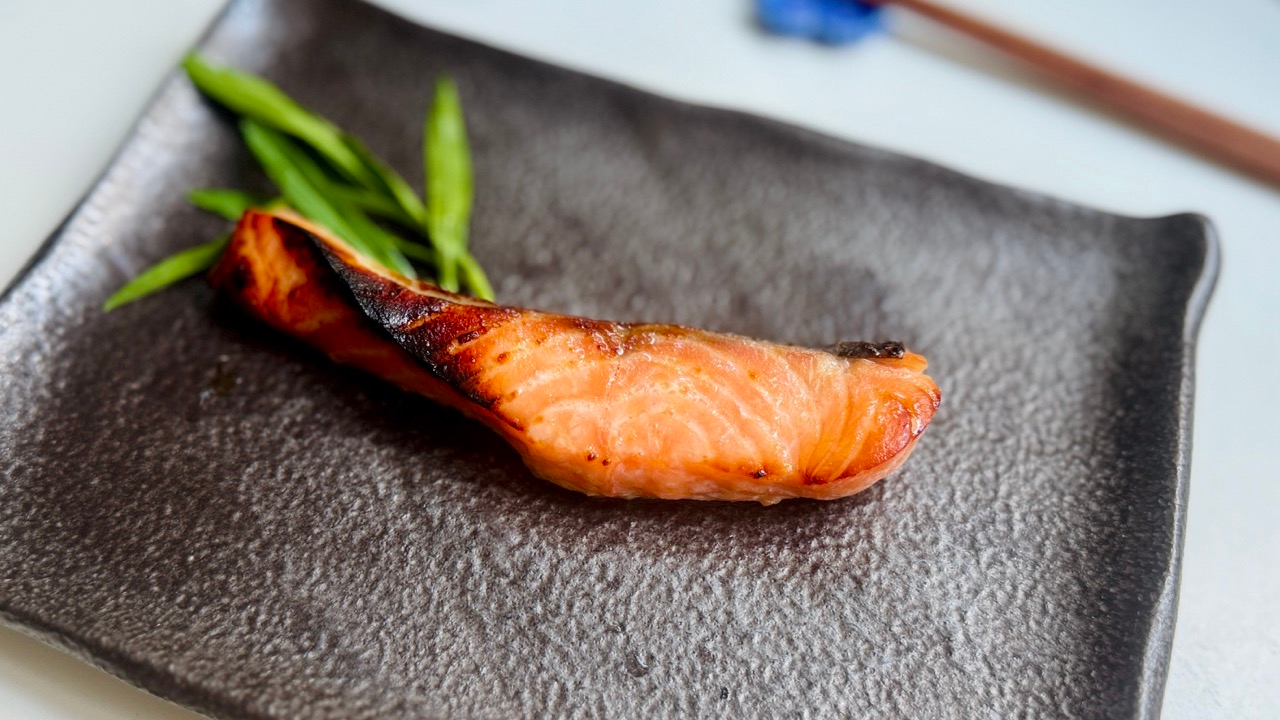
In a traditional Japanese home, grilled fish is an everyday staple. Growing up in my hometown of Numazu—a coastal region famous for himono (sun-dried fish)—simple salted and dried fish was our daily go-to. Whenever salmon saikyo yaki made an appearance on our dinner table, the whole family felt like we were dining at a high-end restaurant.
What is Saikyo Yaki?

Saikyo Yaki (西京焼き) features cuts of fish or meat marinated in Saikyo Miso, a pale, naturally sweet white miso native to Kyoto. The marinade’s rich umami deeply penetrates the fish, yielding a plump, deeply savory, and lightly caramelized finish. While black cod (gindara) is my personal gold standard, salmon offers a rich, widely accessible alternative that pairs beautifully with sweet miso.
In this recipe, I use homemade amakoji (sweet rice ferment) to elevate the natural sweetness and umami, though classic mirin and sugar work great too!
Which Fish Works Best for Saikyo Yaki?

Saikyo Yaki shines brightest with fatty, tender-fleshed fish that absorb the sweet marinade without drying out:
- Black Cod (Gindara): The ultimate crowd-pleaser and my personal favorite. Its exceptionally high fat content creates an ultra-plump, buttery texture.
- Spanish Mackerel (Sawara): The quintessential classic choice in Japan, offering an elegant, delicate umami.
- Salmon (Sake): Widely available at Western grocery stores (such as Trader Joe’s). Its rich oils keep the flesh moist and forgiving.
- Mackerel (Saba): Deeply flavorful and oily, standing up boldly to the velvety white miso.
- Red Ocean Perch (Aka-uo) & Alfonsino (Kinmedai): Refined white fish with subtle sweetness and succulent flesh.
Ingredients & Ratios

Yield: 4 portions
- Salmon: 0.8 lb (~360g) BBQ Cut Salmon, sliced horizontally into 4 thinner portions (~90g each)
- Coarse Salt: A generous pinch (for prepping the fish)
- Saikyo White Miso: 75g
- Homemade Amakoji: 75g (Substitution: 1.5 tbsp mirin + 1 tsp sugar)
- Japanese Sake: 35g (~2.5 tbsp)
How to Make Salmon Saikyo Yaki Step-by-Step
1. Prep the Fish

Arrange the salmon slices on paper towels and sprinkle lightly with coarse salt. Let sit for 15–20 minutes to draw out excess surface moisture and fishiness, then pat completely dry.
2. Whisk the Marinade

In a small bowl, whisk together the Saikyo miso (75g), amakoji (75g), and sake (35g) until smooth and emulsified.
3. Marinate Overnight

Place the salmon slices and marinade into a ziplock bag, press out excess air, and seal. Gently massage so every slice is evenly coated. Refrigerate for 12 to 24 hours.
4. Scrape Off Excess Paste

Remove the salmon from the bag and gently wipe off excess marinade with a paper towel, leaving a sheer film for flavor. (Testing note: I even tried washing off the marinade on half the salmon as an experiment; because the fish absorbs the flavor deeply overnight, it still turned out perfectly savory and balanced!)
5. Cook to Caramelized Perfection


- Oven / Broiler Method: Line a baking tray or grill dish with non-stick foil (such as Reynolds Wrap Non-Stick with the silicone side up), parchment paper, or regular foil lightly coated with cooking spray. Place the salmon on the top rack of an oven preheated to 380°F (190°C). Bake for 8 minutes, then switch to the broiler for 2 minutes to achieve a delicate, blistered finish.
- Alternative Cookware: A tabletop Japanese fish roaster (like a Zojirushi) yields restaurant-grade results, but an air fryer or toaster oven set to 375°F for 8–10 minutes works wonderfully as well.
What If You Can’t Find Saikyo White Miso?

Standard yellow or white rice miso (kome miso) contains significantly more salt than Saikyo miso. If substituting, adjust the ratios and reduce your marinating time to offset the salinity:
- Option 1: Saikyo Miso Base (200g Batch)
- 200g Saikyo Miso + 1 tbsp Sake + 1 tbsp Mirin + 2 tsp Sugar
- 200g Saikyo Miso + 1 tbsp Sake + 1 tbsp Mirin + 2 tsp Sugar
- Option 2: Standard Rice Miso Base (200g Batch)
- 200g Rice Miso + 1 tbsp Sake + 2 tbsp Mirin + 1 tbsp Sugar
Chef’s Tip: When using standard rice miso, marinate for only 6 to 12 hours so the fish doesn’t cure too tightly or become overly salty.
Storage & Freezing Guide

Saikyo Yaki is ideal for meal prep because the fermented miso acts as a natural preservative.
- Refrigeration: Marinating raw fish can remain in the fridge for 3 to 4 days. Cooked leftovers keep in a tightly wrapped container for 1 to 3 days (reheat gently over low heat).
- Freezing (Pre-Seasoned Freezer Prep): Wrap raw fillets individually in plastic wrap with a thin coating of miso paste still intact, then seal in a freezer bag for up to 1 month. The miso forms a protective barrier against freezer burn.
- Thawing & Cooking: Transfer frozen fillets to the refrigerator about 12 hours (half a day) before cooking to defrost slowly. Always wipe away thick paste clumps prior to heating so the marinade doesn’t char over direct heat.
Salmon Saikyo Yaki FAQs
Q: Why does Saikyo Yaki burn so easily, and how can I prevent it?
A: Miso and amakoji are rich in natural sugars that caramelize quickly under heat. To prevent charring:
- Gently wipe off thick clumps of marinade with a paper towel before cooking (a thin film left behind is plenty for rich flavor).
- Cook over medium-low heat or keep the pan on the top oven rack rather than directly under a flame until the final 1–2 minutes.
Q: Can I marinate the salmon for longer than 24 hours?
A: Yes! With naturally low-sodium Saikyo Miso, marinating for 1 to 2 days (24 to 48 hours) is actually the sweet spot for peak flavor penetration and melt-in-your-mouth umami.
- Ideal window: 24 to 48 hours for the best balance of sweetness and seasoning.
- Maximum limit: Up to 3 to 4 days in the refrigerator. Beyond 4 days, the salt will draw out too much moisture, leaving the fish overly salty and firm.
- Prep-ahead tip: If you can’t cook the fish within 3 days, scrape off or lightly rinse off the miso paste, pat the fillets completely dry with a paper towel, wrap them tightly in plastic wrap, and freeze for up to 1 month.
- Note for regular miso: If substituting standard white/yellow rice miso (which contains much higher salinity), stick to a shorter 6 to 12 hours so the fish doesn’t cure too tightly.
Q: Can I use frozen salmon fillets?
A: Yes! Thaw the salmon completely in the refrigerator overnight first. It is crucial to pat the thawed fillets completely dry with paper towels to remove excess surface moisture before sprinkling with salt, ensuring the marinade isn’t diluted.
Q: What if I don’t have amakoji?
A: You can easily swap the 75g of amakoji for 1.5 tablespoons of mirin plus 1 teaspoon of sugar (or honey). Amakoji gives a softer, fermented depth of sweetness, but mirin provides a lovely gloss and traditional sweet glaze.
Q: Can I reuse the leftover Saikyo miso marinade?
A: Absolutely! Throwing away leftover Saikyo paste is a waste because it’s packed with rich umami and subtle fish flavor. Because it has come into contact with raw fish, you must handle it safely, but you can easily recycle it in two clever ways:
- Reuse as a Second Marinade Base (Heat & Cool First): Transfer the leftover paste to a small saucepan and heat gently over low heat, stirring constantly to evaporate excess moisture and remove any raw fish odors. Let it cool completely, then use it to marinate chicken, pork, tofu, or vegetables (like cucumbers or daikon radish).
- Use as a Flavor-Packed Seasoning: Add a spoonful directly into cooked dishes! It works wonderfully as:
- A sauce for Pork & Vegetable Miso Stir-Fry (Butaniku no Miso-Itame)
- A simmering base for Miso-Simmered Fish (Saba no Miso-Ni)
- A quick dip for fresh cucumber or radish sticks
- An umami booster stirred into your daily Miso Soup

Amakoji Salmon Saikyo Yaki (Sweet Miso-Marinated Salmon)
Ingredients
Salmon Prep
- o.8 lb Salmon Fillet (BBQ Cut, sliced into 4 thinner portions)
- 1 pinch salt (for drawing out excess moisture)
Saikyo Amakoji Marinade
- 75 g Saikyo White Miso (approx. 3.5 tbsp)
- 75 g Homemade Amakoji (approx. 3.5 tbsp; or substitute 1.5 tbsp mirin + 1 tsp sugar)
- 35 g Japanese Sake (approx. 2.5 tbsp)
Instructions
- Arrange the 4 salmon slices on paper towels and sprinkle lightly with coarse salt. Let sit for 15–20 minutes to draw out surface moisture and fishiness, then pat completely dry with clean paper towels.

- In a small bowl, whisk together the Saikyo white miso (75g), amakoji (75g), and sake (35g) until completely smooth and emulsified.

- Place the salmon slices and marinade into a ziplock bag. Press out excess air, seal, and gently massage so every slice is fully coated. Refrigerate for 12 to 24 hours (up to 48 hours for maximum depth of flavor).

- Remove the salmon from the bag and gently wipe off excess marinade with paper towels. Leave a sheer film for flavor, but wipe away thick clumps to prevent burning during cooking.

- Line a baking tray with non-stick aluminum foil (silicone side up) or parchment paper.

- Place salmon on the top rack of an oven preheated to 380°F (190°C). Bake for 8 minutes, then switch to the broiler for 2 minutes until lightly caramelized and blistered.

Notes
- Oven Foil Options: Non-stick foil with a silicone coating (such as Reynolds Wrap Non-Stick) allows sticky miso-glazed fish to release effortlessly without oil. Regular parchment paper or oil-sprayed foil can also be used.
- Saikyo Miso Substitution: If using standard white/yellow rice miso (kome miso), mix 200g miso + 1 tbsp sake + 2 tbsp mirin + 1 tbsp sugar, and reduce marinating time to 6–12 hours to avoid over-salting.
- Storage & Freezing: Marinating raw salmon keeps in the fridge for up to 3–4 days. To freeze for up to 1 month, leave a thin film of miso paste on the raw fillets, wrap tightly in plastic wrap, and store in a zip bag. Thaw in the refrigerator 12 hours before cooking.
