
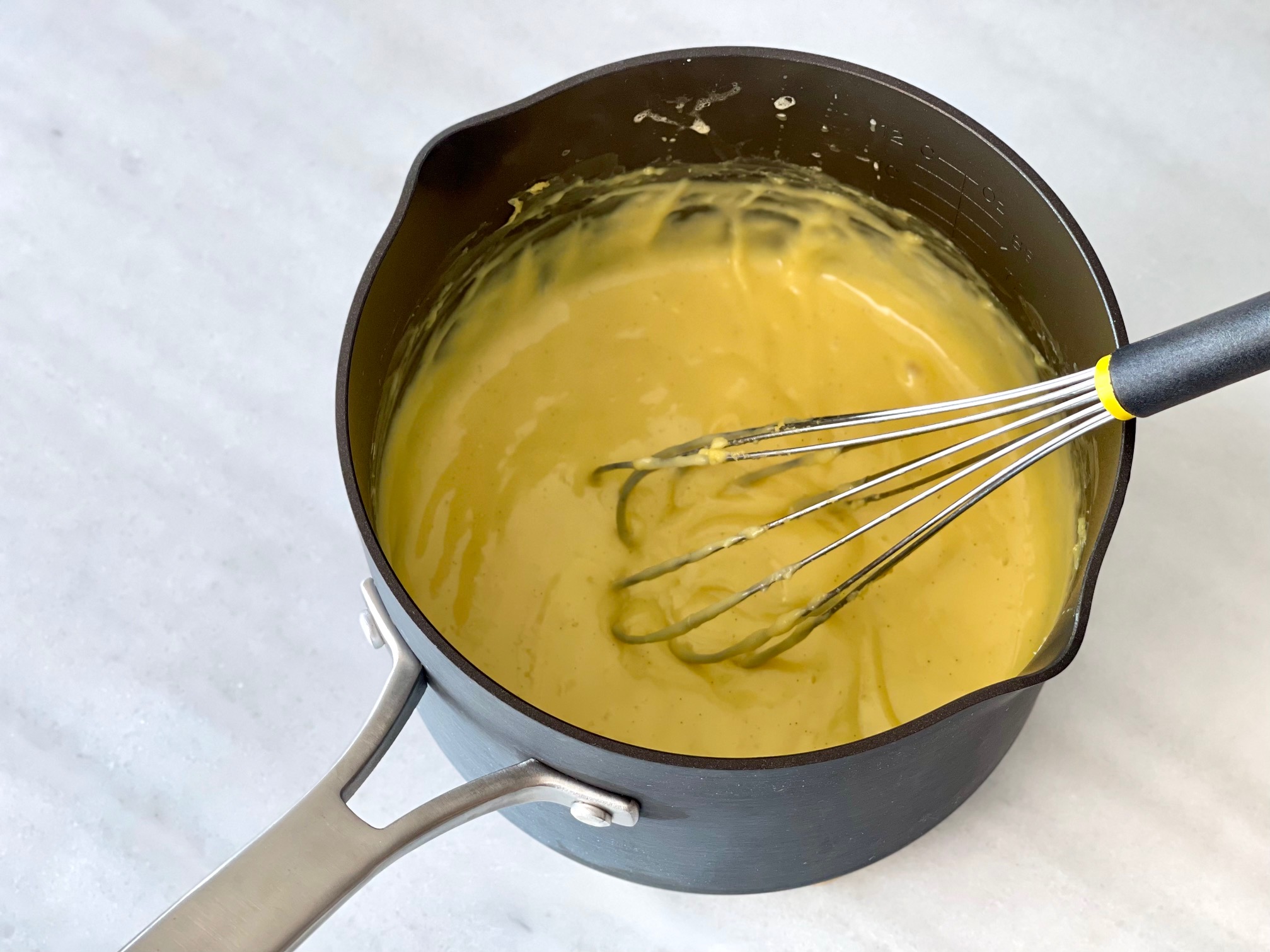
Pastry cream—or crème pâtissière—is the absolute foundation of French pastry. It is a classic component that I have made thousands of times throughout my career, learning different nuances from various chefs along the way.
This particular recipe is my definitive, go-to version. It yields a pastry cream that is exceptionally rich, thick, and velvety, boasting a deep hue thanks to a high ratio of egg yolks. It is incredibly versatile and serves as the backbone for countless high-end desserts.
What is Pastry Cream?

Crème pâtissière is a classic French custard cooked on the stovetop. Made from milk, egg yolks, sugar, and a starch stabilizer, it is cooked until thick and glossy. Unlike a pouring custard (crème anglaise), pastry cream holds its shape beautifully, making it the ideal filling for tarts, cream puffs, éclairs, and cakes.
Ingredients for Pastry Cream

To achieve a professional-grade cream, every ingredient choice matters:
- Whole Milk: Always use whole milk. Lower-fat alternatives (like skim or reduced-fat) lack the fat content required to give the cream its signature rich mouthfeel.
- Egg Yolks: While some recipes use whole eggs, this recipe relies exclusively on egg yolks. This creates an incredibly luxurious texture and a vibrant golden color.
- Sugar: Stick to granulated white sugar or caster sugar. Unrefined sugars like brown sugar will alter the delicate flavor profile and muddy the beautiful golden color of the cream.
- The Starch Agent: I use a precise combination of pastry flour and cornstarch. Flour gives the cream a traditional body, while cornstarch keeps it smooth and stable. If you have access to professional pastry cream powder (poudre à crème or high-quality custard powder), you can swap it in for the cornstarch to achieve an even silkier texture.
- Vanilla: Real vanilla beans yield the most exceptional aroma and visual spec. However, high-quality vanilla paste or pure vanilla extract is excellent too. Because pure extracts contain alcohol, they actually help extend the shelf life of the cream slightly.
Professional Variations
- Butter: Can be added at the very end to give the cream a glossy sheen and a melt-in-the-mouth texture. For this absolute basic version, we are omitting it, but it’s a wonderful upgrade.
- Gelatin: Often used in commercial pastry shops to ensure the cream holds up perfectly in takeout desserts.
- Heavy Cream: Can replace a portion of the milk for an even richer profile, though it strays from the classic base.
Pro-Tips & Common Mistakes
1. Whisk the Sugar and Yolks Immediately

Never let sugar sit on top of egg yolks without mixing. Sugar is hygroscopic and will draw moisture out of the yolks, “curing” them and creating tiny, hard yellow lumps that will not dissolve during cooking. Whisk them immediately upon combining.
2. Continuous, Vigorously Whisking
Cooking pastry cream is a physical workout. You must whisk constantly and vigorously over the heat, ensuring you scrape the bottom and the sharp corners of the pan. Beginners often miss the edges, leading to scorched spots or lumps.
3. Medium Heat is Safest

In professional kitchens, we often cook pastry cream over medium-high heat because it flashes the starch quickly and prevents gluten development. However, for home bakers, medium heat offers the best balance of speed and control to prevent catching.
4. Don’t Stop Cooking Too Early!
This is the most common mistake. When the mixture begins to thicken, the egg yolks are cooking, but the starch is not yet fully activated. You must keep cooking and whisking until the mixture thins out slightly, becomes beautifully glossy, and you see large bubbles breaking the surface. This ensures the starch is thoroughly cooked, removing any raw, floury taste.
Chef’s Troubleshooting: “Do Not Worry”
- If you get tiny lumps: Simply pass the hot pastry cream through a fine-mesh strainer immediately after removing it from the heat.
- If it sets firmly: Pastry cream should become firm and jelly-like once fully chilled—this means your starch bloomed perfectly. Before using it, simply beat it vigorously with a spatula or a stand mixer fitted with the paddle attachment to restore its smooth, pipeable elegance.
How to Store Pastry Cream

Transfer the hot cream to a shallow pan lined with plastic wrap, and press a second sheet of plastic wrap directly onto the surface of the cream. This prevents a hard skin from forming. Chill immediately.
Pastry cream will keep in the refrigerator for up to 3 days.
- Can you freeze it? Standard pastry cream does not freeze well; the starch bonds break down upon thawing, causing the cream to weep and separate. However, if you fold in whipped cream to create a Diplomat Cream, it stabilizes beautifully and can be frozen successfully.
- Chef’s Shelf-Life Extension: When loosening the chilled cream before use, I like to whisk in a splash of premium liqueur, such as Grand Marnier or Cointreau. The alcohol content safely extends the shelf life by an extra day or two while adding a beautiful, sophisticated note to the flavor profile.

Classic Crème Pâtissière (Professional Pastry Cream)
Ingredients
- 473 ml Whole milk
- 1 pc Whole vanilla bean or 1 tbsp pure vanilla paste/extract
- 120 g egg yolks (about 8 large eggs)
- 150 g Granulated white sugar or caster sugar
- 23 g Pastry flour or AP flour sifted
- 12 g Cornstarch sifted
Instructions
- Sift the pastry flour and cornstarch together into a small bowl and set aside. Line a shallow baking sheet or quarter-sheet pan with premium plastic wrap.

- Slice the vanilla bean lengthwise and scrape out the seeds. Add both the seeds and the empty pod into a medium, heavy-bottomed saucepan with the whole milk. Heat over medium until it reaches a gentle simmer, then remove from heat to steep.

- In a large mixing bowl, combine the egg yolks and granulated sugar. Whisk immediately and vigorously until the mixture becomes pale yellow, thick, and falls in ribbons.

- (Pro-tip: Never let sugar sit unmixed on yolks, or it will curdle them into hard, irreversible lumps).

- Add the sifted flour and cornstarch to the egg yolk mixture. Whisk gently only until just incorporated to prevent over-activating the gluten.

- Discard the vanilla bean pod from the warm milk. While whisking the egg mixture continuously with one hand, slowly pour a steady stream of about one-third of the warm milk into the bowl to temper the yolks. Once completely smooth, whisk in the remaining milk.

- Pour the entire loose mixture back into the saucepan. Place over medium heat and whisk rapidly and continuously, ensuring you reach all the way into the bottom seams and corner edges of the pan to prevent scorching.

- Place over medium heat and whisk rapidly and continuously, ensuring you reach all the way into the bottom seams and corner edges of the pan to prevent scorching.

- As the mixture thickens dramatically, keep whisking hard. Once it transitions from a dull paste to a beautiful, smooth, glossy cream and large bubbles break the surface, continue cooking for exactly 30 to 45 seconds. This fully cooks the starch and eliminates raw flour flavors.

- Immediately remove from heat and pour the hot cream onto your prepared shallow pan. Smooth it out flat. Press a sheet of plastic wrap directly onto the surface of the cream (touch-top) to prevent a skin from forming. Chill in the refrigerator until completely cold (at least 2 hours).

- Once thoroughly chilled, the cream will have a firm, jelly-like set. Transfer it to a clean bowl and beat vigorously with a flexible spatula or a stand mixer fitted with a paddle attachment until it completely softens into a luxurious, silky, pipeable elegance.

- (Tips: For an absolutely flawless, professional outcome, pass the loosened cream through a fine-mesh strainer one final time using a spatula. This extra polish breaks down any microscopic graininess and ensures the ultimate smooth and silky mouthfeel.)

Notes
- Gluten Management: Using pastry flour instead of all-purpose flour lowers protein content, yielding a cleaner break and a less stringy cream.
- The Science of Starch Cooking: Do not panic when the cream thickens. You must continue cooking past the initial thickening stage until the amylase enzymes are neutralized and the starch is fully hydrated, which actually relaxes the texture slightly and adds gloss.
- Shelf Life & Preservation: Lasts up to 3 days refrigerated. Adding 35% ABV pure vanilla extract or a splash of orange liqueur preserves it for an extra 24–48 hours by slowing down retrogradation and microbial growth. Do not freeze raw pastry cream as it will break and weep upon thawing.
